Standard 1: Policy for internal quality assurance
Ascencia Malta is a higher education institution offering training courses at levels 5, 6, 7 and 8, as well as a fully accredited English Language School. Under the steadfast leadership of Ms. Marthese Giordmaina, who has expertly guided the institution since its inception four years ago, Ascencia Malta continues to uphold its commitment to academic excellence.
The school is founded around three values that constitute its identity:
International Openness: Programmes are designed to welcome international students and facilitate their mobility.
Educational excellence: Ascencia Malta’s objective is to be recognized in its specialty field and offers its students a guarantee of inclusion in the global employment markets. The teaching team consists of an academic faculty and the best professional speakers.
Individual support towards employment: Each training corresponds to a personal ambition; all learners benefit from individualized support. Success of all – before, during and after training – is at the heart of our work. Our teams accompany each student to the success of his project. Professional integration, promoted by periods in the company, is our top priority.
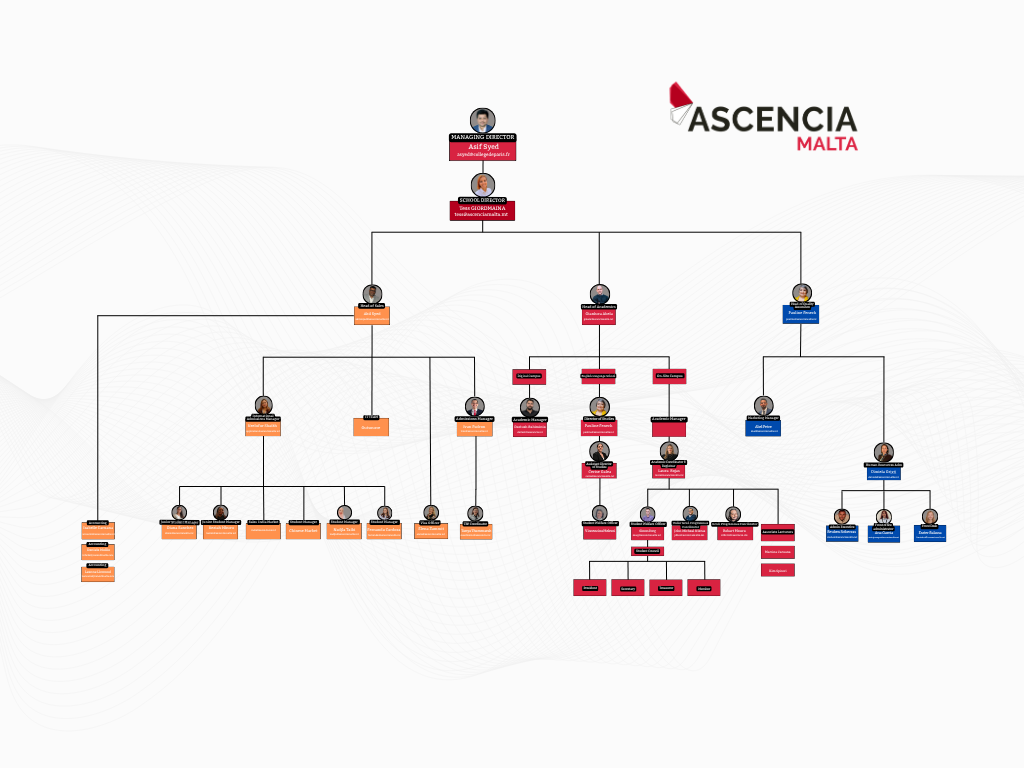
Organization Chart
The quality of its training and the satisfaction of its staff and students is a priority for Ascencia Malta. Therefore, in organizing the opening of its new campus, Ascencia Malta has built a quality policy to meet the 11 standards of the MFHEA.
The school comprises three main departments, the management represented by the School Director, the sales department, and the pedagogical department.
According to their scope of action, these three departments play a role in the school’s quality system.
The School Director is responsible for compliance with quality standards by all the school’s stakeholders. In addition, the School Director manages the school’s quality system and controls the proper implementation of the recommended tools for monitoring daily actions.
The Pedagogical Service is the interface between the school, students, and teachers. Its role is to follow students throughout their training path. It plans the year of students and teachers. It is also the service that collects the complaints of the various parties and provides an answer. The pedagogical service transmits to students and teachers the various satisfaction surveys throughout the training and ensures obtaining as many answers as possible.
The Sales Department is primarily the guarantor of the smooth running of the student admission process in the school. But they are also the students’ career advisors; they help and accompany the students in their search for an internship and guarantee the smooth running of this period. In addition, they are the interlocutors connecting the school, companies and students. They organize at least one visit to a company during the internship period and intervene if necessary.
Students are stakeholders in the quality system as beneficiaries of training actions. They are the main players in satisfaction surveys since we await their answers to consider their possible complaints to implement our continuous improvement approach.
The teachers’ role is to transmit their knowledge to learners and are guarantors of the quality of their courses. In addition, they provide the school’s pedagogical service with all the pedagogical documents and materials needed to control the intervention quality.
Recruitment is the responsibility of the heads of departments according to the hierarchical position of the profiles sought.
The school’s Director is recruited directly by the founder and president of the institution, Dr Olivier de Lagarde. It is the role of the School Director to recruit all other employees to join the Ascencia Malta team.
The Academic Manager/s will be responsible for recruiting the educational coordinators and the educational assistant. The Academic Managers’ particularity is that they are also responsible for recruiting the teaching team in close collaboration with the School Director.
The heads of the department report recruitment needs to the School Director, who validates or not the request and the allocated budget.
When the need is validated, the Recruitment Process is launched. Recruitment activities may be coordinated either by the Head of the relevant Department or delegated to the Human Resources, in alignment with institutional protocols and workforce planning strategies.
To guarantee all our stakeholders the quality of our training, we are committed to:
-
Maintaining high standards to guarantee results of excellence.
-
Conducting regular follow-ups with students, teachers, and teams to ensure their satisfaction.
-
Providing the necessary help and support according to the needs of the students.
-
Guaranteeing the realisation of their training by a trainer experienced in his field of intervention.
-
Ensuring technical and pedagogical follow-up for all training-related matters.
To meet our commitments, Ascencia Malta has put in place procedures and tools allowing it to:
-
Analyse and design the training action
-
Selection of stakeholders based on their skills,
-
Accompaniment of trainers in their pedagogical know-how,
-
Design appropriate training activities and formalise them in writing,
-
To lead the training action.
-
Considering the collective and individual expectations of the participants in the training,
-
Ensure the comfort of trainees during training,
-
Provide the trainee with pedagogical support,
-
Evaluate the training action ;
-
Provide an evaluation questionnaire at the end of each training action,
-
Analyse the reasons for malfunctions if necessary and implement corrective actions.
The standards for internal quality assurance are:
-
1. Policy for Internal Quality Assurance
-
2. Institutional probity
-
3. Design and approval of programmes
-
4. Student-centred learning, teaching and assessment
-
5. Student admission, progression, recognition, and certification
-
6. Teaching staff
-
7. Student support services
-
8. Information management
-
9. Public information
-
10. On-going monitoring and periodic review of programmes
-
11. Cyclical external quality assurance.
Ascencia Malta’s Quality Policy is publicly accessible and is subject to periodic review to ensure its continued relevance and effectiveness. Reviews are conducted annually or as necessary in response to significant organisational or regulatory changes.
Standard 2: Institutional probity
Finance
As per existing Malta Business Registry requirements, the institution, as a company, is obliged to file audited accounts yearly. The yearly financials, tax compliance and audit services are being taken care of by Sky Consultants. The procedures aligned with Malta Company Law and International Accounting Standards (IFRS).
The current shareholding structure of Ascencia Malta comprises Collège De Paris SAS, registered under number 815229901, as the holder of 50% of the shares, with the remaining 50% held by Mr Asif Iqbal Syed. The professionals behind Ascencia Malta are the same professionals behind other successful educational institutions worldwide. As a result, everyone involved in setting up this institution, including the School Director of Ascencia Malta, have ample experience within the field, inevitably providing a certain level of financial security to the institution being set up.
Anti-Corruption and Anti-Bribery:
Introduction:
Ascencia is committed to maintaining the highest standards of integrity, transparency, and accountability. As part of our core values, we firmly reject all forms of corruption and bribery. This section of our global Internal Quality Policy outlines our unwavering commitment to preventing corruption and bribery within our institution and sets forth the principles and guidelines for maintaining an ethical and corruption-free environment.
Policy Statement:
Ascencia is dedicated to conducting all its activities, operations, and interactions with the utmost honesty and integrity. We prohibit any form of corruption, bribery, or unethical behaviour within our institution and expect all members of our community, including senior and junior employees, students, contractors, and partners, to adhere to these principles.
Guiding Principles:
-
1. Zero Tolerance: Ascencia maintains a zero-tolerance stance towards corruption and bribery in any form. Any individual found engaging in such activities will face strict disciplinary actions, including termination of employment or expulsion.
-
2. Transparency: We promote transparency in all financial transactions, decision-making processes, and interactions. All financial records and transactions must be accurately documented and will be made accessible for auditing purposes.
-
3. Conflict of Interest: Any conflicts of interest, whether potential or actual, must be disclosed promptly. Any individual involved in the running of the school must not use their positions to gain personal advantages of any type. Decisions involving conflicts of interest must be made impartially with the involvement of the School’s Director.
-
4. Gifts and Hospitality: Employees and representatives of Ascencia must not solicit, offer, or accept gifts, entertainment, or hospitality that could compromise their judgment or influence their decisions. Token gifts of nominal value may be accepted, but anything beyond must be reported and approved.
-
5. Reporting Mechanism: Ascencia encourages the reporting of any suspected or observed instances of corruption or bribery. An anonymous reporting mechanism will be established to ensure protection for those who come forward with information.
Process Overview for a Safe and Secure Reporting Platform:
-
Accessible Channels: Ascencia will provide multiple avenues for anonymous reporting. These may include an online reporting portal, a dedicated email address, or physical suggestion boxes strategically placed around campus.
-
Initial Report Submission: A previously agreed upon external auditor shall submit a detailed description of the incident, including relevant details such as date, time, location, individuals involved (if known), and any supporting evidence.
-
Identification Protection: The external auditor will assign a unique identifier to the reporter, ensuring their anonymity. No identifying information will be shared with Ascencia’s management or investigators.
-
Review and Assessment: The received reports will be assessed by a designated committee comprising the School Director, Academic Manager, assistant Director of English Studies and Admissions Manager. This committee will be responsible for initiating the appropriate course of action, providing that the report of the incident does not implicate any one of them. Should the report implicate any one of them, they shall be excluded from the review committee until evidence can be produced to exonerate them.
-
Investigation: If the appropriate course of action is an internal investigation, such investigation will be launched, involving relevant personnel such as external auditors and legal experts. The investigation will be conducted discreetly, comprehensively, and with the full cooperation of Ascencia’s management.
-
Action and Follow-up: Depending on the investigation’s findings, the review committee will determine the necessary actions, which may include disciplinary measures, policy updates, or process improvements. A timeline for implementing these actions will be established, and regular progress updates will be shared with all stakeholders, including with the external auditor.
-
Closure and Feedback: Once the matter is resolved, the committee will provide written feedback to the reporter, assuring them that their concerns were taken seriously and informing them of the appropriate actions taken.
-
6. Training and Awareness: Regular training programs, such as CPD sessions and information workshops, will be conducted to educate all members of the Ascencia community about the risks of corruption and bribery and to provide them with the knowledge and tools to identify and prevent such activities.
-
7. Due Diligence: Ascencia will exercise due diligence when entering into relationships with contractors, suppliers, partners, and third parties, ensuring they share our commitment to ethical conduct.
-
Conclusion:
By adhering to this Anti-Corruption and Anti-Bribery Policy, Ascencia reaffirms its dedication to maintaining a corruption-free and ethical environment for all its stakeholders. Upholding these principles is crucial to preserving our reputation as a reputable and trusted institution that contributes positively to the educational landscape in Malta and to Maltese society as a whole.
Leading Staff:
Ms. Marthese GIORDMAINA runs Ascencia Malta and is the School Director. The role of the School Director is to manage the school and teams. In addition, she is the guarantor of compliance with the school’s internal rules by the various stakeholders.
Other key staff members include:
-
Dr Gianluca Abela as Academic Manager for Higher Education
-
Cerise Galea as Assistant Director of Studies for the English Department
-
Ivan Padron as Admissions Manager
-
Simon Borg Barker as Student Welfare Officer
The school is run by a professional with a Level 7 degree in business management or higher education. A minimum professional experience of 5 years in a similar position was considered for the position of School Director.
The Pedagogical Team will consist of professionals who have obtained a minimum Level 5/6 diploma in the field of training or management assistantship. These operational teams are composed of professionals who accompany the students throughout their training. Educational coordinators must show a good sense of relational skills. They are responsible for drawing up timetables and maintaining the relationship between the teachers and the school, as well as between the students and the school.
Regarding the teaching staff, teachers must have an MQF level qualification above the level of the course being taught. For example, teachers of Level 6 programmes must have obtained a Level 7 qualification. Teachers of Level 7 programmes must have obtained a Level 8 qualification. Professional experience in the field taught is also considered in the recruitment of teachers. Additionally, relevant professional experience in the subject area is a key consideration during the recruitment process. English Language Teachers are carefully vetted to ensure they hold the necessary permits.
The sales team will not need to have a specific level of qualification, but they must demonstrate a strong interest in the field of training and have knowledge of the courses offered by the school.
Standard 3: Design and approval programmes
All Ascencia Malta training programmes are recognised and meet the qualification requirements of the MQF; the MFHEA accredits them. The courses are weighted in ECTS, and each course has defined general objectives, learning outcomes, and specific skills the student must acquire. According to the MFHEA’s goals for Higher Education, the learner must be an active player in their training and learning and so, all Ascencia training courses provide a degree of autonomy to allow the learners to apply their knowledge.
Ascencia Malta’s Academic Manager is responsible for deploying training courses to students. He must also ensure that stakeholders put in place appropriate teaching methods. The training programmes are regularly adapted to correspond to the evolution of the relevant trades. Additionally, during the biannual self-evaluation process, the institution actively incorporates professional engagement – such as the participation of industry experts in initiatives like the business conference and thematic talks organized for students – to ensure ongoing alignment with market needs and educational relevance
A development board is set up to improve the training and its dispensation mechanism continuously. Its actions are to:
-
Rely on a watch cell, a veritable observatory expert in activity.
-
Predict and anticipate the future, needs, skills and knowledge of tomorrow.
-
Provide a critical view of existing programmes to update and optimise.
-
Monitor and advise the direction of certification to increase its recognition.
-
School representatives report on the results of student and stakeholder satisfaction surveys.
The members of the development board have a common goal:
-
Analyse the quantitative and qualitative data of the title and its environment
-
Self-assess results to understand developments
-
Advocate for continuous improvements to provide
Standard 4: Student-centered Learning, Teaching and
Assessment
(1) To ensure the quality of its training and the success of its students, Ascencia Malta implements various pedagogical methods combining moments of peer grouping within the school, and periods of autonomy.
The E-Ascencia platform is a pedagogical resource available to students.
We aim to offer our students educational innovations; our training programmes are thus designed around theoretical courses and practice through situations, real cases of companies, and collaborative courses.
Our evaluation methods vary to expose students to different situations throughout the course. For example, the evaluation can take the form of a case study in which the student must analyse the situation and provide answers using his knowledge and critical judgment, an oral presentation, group work, and activation participation in a creative challenge.
Diversifying teaching methods and evaluations allows students to perform to their strengths and prepare for the job market.
At the beginning of every course offered by Ascencia, students will be informed of the assessment procedures and the conditions for validating their Diploma, Bachelor’s, Master’s and Doctorate courses.
The feedback to be given to students is treated with utmost importance. For continuous testing and as part of the module assessment, the students will receive comments from their teachers on their papers. In the case of case studies, candidates have the option of requesting access to the assessment grid that is completed by the marker.
(2) Ascencia Malta is committed to academic integrity on the part of both its lecturers and students. To do this, Ascencia Malta acts against exam fraud through various actions.
In particular, the following facts are considered fraud during an evaluation test:
-
Keep an evaluation-specific document in its possession and communicate it internally or externally.
-
Use materials and documents that are not expressly included in the summons and sub and assessment.
-
Use prohibited means of communication: mobile phones, smartwatches, and similar networked gadgets.
-
Send or receive messages outside: e-mails, texts, electronic conversations, etc.
-
Keep on oneself, for the use of exceptional pauses, any external element to improve the content of its composition.
-
Exchange information with another candidate: copy or draft exchange, electronic discussion, exchange of material, verbal/written exchanges after oral exams between candidates who have passed the test and those awaiting the test.
Take photos, audio or video recordings during written or oral assessments.
This list is non-exhaustive. The Academic Manager can completely sanction any attitude or incident that would interfere with candidates’ equal treatment.
The supervisor/invigilator oversees notifying the Academic Manager, who must immediately stop any fraud or attempted fraud that has been detected: the candidate responsible for the fraud will be excluded from the examination room and sanctioned, which may lead to the elimination of the title.
Depending on the report of the Academic Manager, only the Deliberation Commission will be able to exclude the candidate partially or completely from the certification process and decide whether to access the catch-up tests based on the seriousness of the fraud.
The internet and course materials can be made possible for exams. However, fraud and plagiarism remain strictly prohibited. The institution also has a plagiarism control platform for professional matters. The platform that will be used is Turnitin. This will be used in the control of writing and will make a plagiarism report on the internet and among candidates. The correctors/establishment will therefore be able to sanction a zero, all or part of a copy for fraud.
All markers of examination papers will be given the same evaluation grid for marking the case studies. However, should a student wish to complain about the mark obtained, a second marking by a new marker would be offered.
Students must attend all assessments. In the case of force majeure and with proof of real and serious cause, the student may be offered a make-up exam to compensate for the absence.
If the student fails less than 50% of the exams, the student may also be entitled to a make-up examination session. The make-up examination paper must be the same as the initial examination. The mark obtained cancels and replaces the original mark even in the case of a higher failure.
The teachers mark continuous assessment copies and return them to the students to assess their learning results during the course. In addition, the case study papers are marked according to an assessment grid constructed by the teachers responsible for producing the cases. The copies of continuous assessments and evaluation grids are electronic and archived for five years or longer as required under relevant prescriptive periods on the schools’ servers.
Penalties for fraud
When a fraudulent incident arises, the institution decides on the sanction to be applied to the candidate. Depending on the severity of the fault, it may be decided:
-
To assign a zero rating to the test where the fraud was detected/the incident found,
-
To permanently exclude the candidate from the certification tests,
-
Whether or not to allow the candidate’s EU ironing,
-
Exclude the candidate from certification for up to five years.
The institution’s decision is sovereign and cannot be appealed.
Academic fraud is most likely to arise during examination sessions organised by Ascencia Malta. These would be proctored by members of the teaching staff, lecturers and persons authorised to proctor.
At the beginning of the examination session, the identity of the candidates is checked. To do so, they must present a valid identity document and their invitation to the examination session by the pedagogical services. This checkpoint allows us to ensure that the correct candidate is present at the examination session.
The room is monitored during the examination session to limit the risk of exchanges between candidates. If candidates are seen to be in proximity of each other, they will be asked to leave the room and will be given a mark of 0 with no opportunity to retake the exam.
Candidates write on computers, and when the papers are marked, they run through plagiarism-checking. This software checks for plagiarism on the internet and between papers.
The sanction will be communicated to the candidate in writing and recommended (depending on the seriousness of the fault). It may also be communicated to his company, depending on the size of the sanction.
How to appeal
The certifier provides three cumulative remedies for candidates in a situation of partial validation or adjournment.
The certifier clarifies that an appeal is not a claim or a remark. Instead, it is expressly a request for verification or clarification due to the deliberation or reassessment of the final decision.
The Board has all the elements to make a fair and objective decision.
Points recount
The recount of points is possible for the written end-of-course assessment (case studies) within the limit of an application for an uncredited EU:
-
When? From the first passing session (June).
-
Condition? To have achieved a score 50% lower than the average of the EU end-of-module assessments.
-
Medium? Electronically motivated by the Academic Manager within 48 hours of receiving the results.
NB: The point recount is done by the Academic Manager. He will have to provide proof to the test candidate by scanning the exam copy, revealing the points awarded by the corrector
Right to copy consultation
The right to copy consultation is possible for the written end-of-course assessment (case studies) – within the limit of an uncredited EU – or for the professional defence assessment grid (one or the other):
-
When? At the end of the catch-up session condition? for a lower score than the original session.
-
Medium? By handwritten mail is recommended, motivated by the Academic Manager, within 48 hours of receiving the results.
The documents consulted cannot leave the centre or be reprinted/photographed. The candidate must make themself available for the appointment set within a reasonable 10-day notice period.
Entering the deliberation committee
The commission of deliberation can be referred to as the following framework:
-
When? At the end of the catch-up session
-
Condition? For invalidating the title for a missing EU after written assessments, only if the candidate scored 9.50 or higher and the average of the other blocks would exceed (without coefficient weight) the score of 12/20
-
Medium? By handwritten mail is recommended, motivated to the deliberation committee within ten days of receiving the results.